Search      Advanced Search | Browse By Topic
Magazine Content
Home
Features
Columnists
Industry Risk Reports
In-Depth Series
Special Reports
Point/Counterpoint
R&I One® Content
News & Analysis
Editor's Choice Stories
Resources and Tools
Power Broker® Directory
Risk InnovatorTM
Emerging Risks

Top Employee Benefits Consultant

Executives To Watch
Insights
Industry Events
WorkersComp Forum
Award Nominations
Webinars
RSS
R&I Information
Subscription Center
Advertiser Information
About Us
Contact Us
 

Newsletter Sign-up

Click on the name of the free newsletter below to preview:

R&I One®
WORKERSCOMP Forum TM Update
HTML Text
E-Mail Address:


Click here to unsubscribe
Privacy Policy
Preferences


Mobile app allows real-time use of lift calculator to reduce low-back injuries

Injuries related to lifting are among the most disabling -- and costly -- of all workplace injuries, according to the 2012 Liberty Mutual Workplace Safety Index. Companies looking to reduce lifting-related risks to their employees can now use their smartphones or computer tablets.

Print Email Add to Facebook Add to Twitter Add to LinkedIn Write to the Editor Reprints

The Lift Calculator, developed by the National Institute for Occupational Safety and Health, has been used by employers and safety professionals for more than 30 years. Now, an ergonomics company has created an app to take the NIOSH program to the next level of technology.

"It gives you real-time feedback," said Kent Hatcher, managing consultant for Humantech Inc., which developed the HT NIOSH Lift Calculator app. "Our clients ... are in the warehouse, on the assembly line, and wanted a faster way of getting quick results."

Lift Calculator evolution. The NIOSH program is a tool in the public domain that calculates the stress on the lower back during two-handed lifts or lower tasks. Users were given data tables and instructed to measure work task variables.

"Eventually, they provided a slide rule," Hatcher said. "You would take the variables, pull the tab until it lined up to the window, and get the recommended weight limit to be safely lifted."

For the last decade, companies such as Humantech have used Excel spreadsheets to do the calculations. The company's clients, which include distribution companies, auto suppliers, and heavy equipment employers, requested an easier way to use the calculator.

"They wanted this on the manufacturing floor and didn't want to take their laptops out and run their Excel spreadsheets," he said. "Using smartphones or tablets they have this app. It's taken the place of Excel, which took the place of the slide rule. They can do it right beside the conveyor belt and calculate the stress on the low back."

The user inputs variables such as the horizontal distance to where the load starts or the height of the load off the ground. The program determines the risk level for that lifting task.

"It also gives you opportunities for improvement," Hatcher said. "It will tell you the relative contribution of each [variable] factor and will tell you, 'to have the biggest impact on how safe this lifting task is, you should reduce the horizontal reach from X to X,' for example ... it gives you that real-time feedback."

Software solutions. The app is available to anyone with access to iTunes. It is not, however, the only technical answer to ergonomic problems in the workplace.

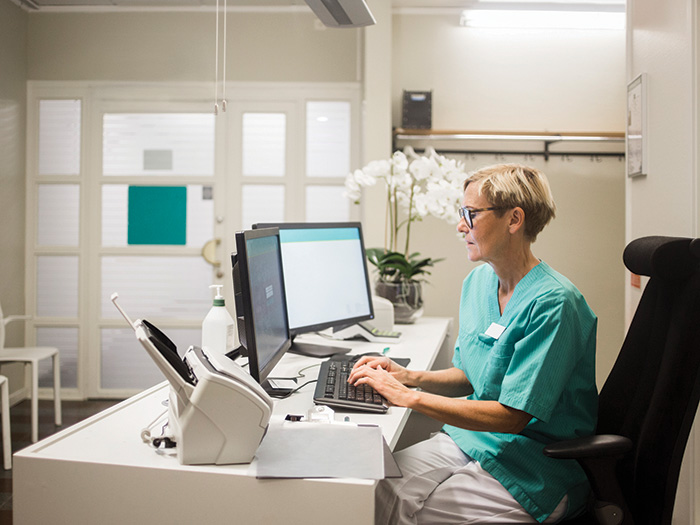
A software program came out of requests from employers for Humantech to do one-on-one ergonomic assessments for office workers. "It's very expensive and time-consuming," Hatcher said. "It takes 20 to 45 minutes to do an ergo assessment."

The company developed an online learning suite. It consists of a half-hour computer-based training program followed by a brief survey. The results are sent to the manager, who gets a prioritized list of needs, which can help with budgeting for equipment in the next year.

"The results of this training and online survey will help triage those ergonomic problems," Hatcher said. "What we hear most from clients is at that 300-person company, they just don't know where to start."

The Ergopoint Office Suite works well, for example, if all employees at a site cannot get together at the same time to learn about chair adjustments. The training can be done via computer.

"It creates a database on how poorly a workstation is set up, so you can get a score assigned to each person," Hatcher said, "so that prioritizes your time as an HR professional to go see those people one-on-one."

Another program is targeted to the industrial environment and provides a vehicle for a company's sites to enter their risk assessment data. Risk Priority Management, or RPM, is a Web-based evaluation program that provides a database of ergo information about the workplace.

"If a [facility] in Brazil comes up with an ergo solution, that gets inputted onto the website," Hatcher said. "All the information is shared across the company platform. With respect to ergonomics, it's about sharing solutions and collaborating to minimize risk."

Read more at the WorkersComp Forum homepage.

June 25, 2012

Copyright 2012© LRP Publications


RISK logo
 

Back to top

Entire contents copyright © 2013 Risk and Insurance® All rights reserved. May not be reproduced in any form without written permission.